
MERCY NOT MERIT
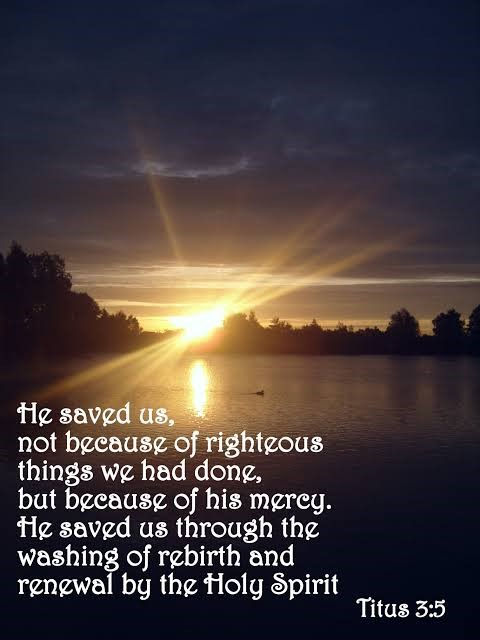
“Not by works of righteousness which we have done, but according to His mercy He saved us, through the washing of regeneration and renewing of the Holy Spirit!” (Titus 3:5 NKJV).
There are some very important comments in our verse about merit and mercy in regards to our salvation.
Merit – “Not by works of righteousness which we have done.” Salvation is not by merit. We do not earn salvation. All the good works in the world will never save a soul. The reason is that our righteousness is not good enough. The prophet Isaiah said, “All our righteousnesses are like filthy rags” (Isa. 64:6). This is a devastating assessment of our works. But it is a revealing comment about the holiness of God. No one can get into heaven unless they are as holy as God. His holiness is so great that our best is as filthy rags in His sight. Once we understand this fact, we will not think “works” for salvation anymore. So many folks are busy doing good deeds to get into heaven not realizing that their best deeds are utterly worthless to save. “Filthy rags” kills merit.
Mercy – “But according to His mercy He saved us.” Merit will not save but that does not mean we cannot be saved. Divine mercy comes to our rescue. It provides regeneration and renewing. First, regeneration. This is the new birth and it comes via the blood of the Lord Jesus Christ. “The washing of regeneration” does not refer to baptism as many believe - that would be a good work which, as we have seen, is futile for salvation. This “washing of regeneration” is the cleansing away of our sin through the blood of the Lord Jesus Christ. It is a spiritual work which God performs for us because of His mercy. Second, renewing. This speaks of progress in our spiritual life. It refers to spiritual growth after the new birth. It is not behavior (works) then belief (salvation). After we are saved we are to grow. Belief must determine behavior. And the Holy Spirit is the One Who helps us to develop spiritually. And it is all of mercy.
(Adapted from Butler’s Daily Bible Reading 3)
Soli Deo Gloria (To God Alone Be The Glory)
Quotation of the Week
“God’s mercy with a sinner is only equaled and perhaps outmatched by His patience with the saints, with you and me!”
Alan Redpath (1907 – 1989)
British Pastor, Theologian and Author
Word Study
Followed
In Luke 5:11 we read, “So when they had brought their boats to land, they forsook all and followed Him” (NKJV).
“Followed” is the Greek word akolouthéō (ἀκολουθέω = ak-ol-oo-theh'-o). It means to go the same way/path, to go somewhere together with someone, to accompany someone, to follow after someone. In classical Greek it referred to soldiers who followed their commander or to slaves who followed their master. In the Septuagint akolouthéō means to go behind, to follow. In context, it is significant to note that Peter and all who were with him, left everything and immediately followed the Lord Jesus! This was a rabbinical way of acknowledging their officially becoming disciples of the Lord Jesus. The essence of Christianity lies in the words of the Lord Jesus, “Follow Me” (cf. Matt. 4:19; Mark 2:14). When we walk with Him, He promised we would never walk in darkness! (cf. John 8:12). He is our Lamp wherever we walk, always walking with us, and His Spirit within us enabling us to “Walk in the Spirit” (Gal 5:16).
Did You Know…
According to 1 Sam. 13:9-14, king Saul offered a burnt offering to God which broke God’s law and ensured that his descendants would not reign after him.
Bible Quiz
What were the Ephesians urged to do in order to stand against "the wiles of the devil?"
**Answer to last week’s Bible Quiz
Which disciple said, “Depart from me, for I am a sinful man, O Lord?” Peter (Luke 5:8).
Prophecies Fulfilled by the Lord Jesus Christ
Words of Grace come from His lips (Psalm 45:2; cf. Luke 4:22; John 1:17)
"You are fairer than the sons of men; grace is poured upon Your lips; therefore God has blessed You forever” (Psalm 45:2 NJKV).
Psalm 45 is a royal wedding song. The Psalmist is describing the marriage ceremony of the Davidic king. In context, the Psalmist begins by simply noting the beauty of the King, saying, “You are fairer than the sons of men.” Most theologians believe the emphasis here is on the character of the Messiah, on the beauty of His nature and personality. Yet Isa. 53:2 says that the Messiah was not remarkable for His physical appearance or beauty. Fulfilled in the Lord Jesus Christ, we can say there was never a more beautiful person than Jesus of Nazareth. “Grace is poured upon Your lips” means that the beauty of the King extends to His words, which are filled with grace. His grace-blessed lips speak grace-filled words. This was marvelously true of the Lord Jesus. In His early years it was said, “So all bore witness to Him, and marveled at the gracious words which proceeded out of His mouth” (Luke 4:22) Even the opponents of the Lord Jesus said, “No man ever spoke like this Man!” (John 7:46). So, it is the beauty of the Lord Jesus’ character, His words, and His works that makes us love Him. 1 Peter.1:8 states, “Whom having not seen you love. Though now you do not see Him, yet believing, you rejoice with joy inexpressible and full of glory.”
Did You Know – Christian History
William Williams, Welsh Evangelist - February 11, 1717
William Williams was born February 11, 1717 in Pantycelyn, Wales. He was a Welsh Evangelist, poet, and hymn-writer.
Williams entered Llwynllwyd Academy at Carmarthen, to study medicine. However, when he was twenty, he attended a Sunday morning service lead by an itinerant preacher, Howell Harris. Harris preached from a tombstone in a church cemetery, preaching to people as they left the church service. This “Tombstone Preacher” so touched Williams that he decided to become an evangelist and preach in every possible place.
Williams was ordained a deacon of the Established Church Abergwesyn in 1740, however his evangelistic views kept him from being ordained a priest. Eventually he began to associate with the Welsh Calvinistic Methodists. This group challenged Williams to update their hymnal by writing hymns. He responded with about 800 hymns, his first “Guide Me, O Thou Great Jehovah.” For the wealth of hymns he produced, Williams is sometimes referred to as “the Watts of Wales” (Isaac Watts wrote original hymns a century earlier in England).
For forty-three years, Williams traveled nearly 100,000 miles on horseback, preaching and singing. One writer states, “He sang Wales into piety.” An accomplished vocalist, Williams has been called the “Sweet Singer of Wales.” He drew crowds of 10,000 or more, one time speaking to an estimated 80,000 people. He noted in his journal that “God strengthened me to speak so loud that most could hear.”
Williams published his first volume of hymns, Hallelujah, in 1744. He also wrote poetry and prose, for use by the members of the Methodist fellowships he established. He wrote two long poems. Golwg ar deyrnas Crist (A view of Christ’s kingdom), written in 1756 deals with the history of salvation and God’s grace in Christ. Bywyd a marwolaeth Theomemphus, written in 1764, speaks of conversion and Christian living. He also published seven hymnals, two of which were in English. In all, he published nearly ninety books and pamphlets. And although William never left his native Wales, his beloved hymn has influenced Christians throughout the world. Originally written in Welsh, it has been translated into over seventy languages. Williams died on January 11, 1791, at Pantycelyn, aged 73.
A Little Humor
When her teacher asked how long it was between the Lord Jesus’ arrival in Jerusalem and His death, the little girl looked worried. “Can I phone a friend?”
Thought Provoking Church Sign
“Google cannot satisfy every search!”


Comments